Celebrate School Choice: January 22-28, 2017

Celebrate School Choice: January 22-28, 2017
 
Held every January, National School Choice Week is an independent public awareness effort designed to shine a positive spotlight on effective education options for every child. Supporters of school choice will come together for a breakfast at the Idaho State Capitol to kick off School Choice Week in the state on Monday, January 23.
 
At 9:00 am, parents, students, teachers, principals from nearly every school option will come together to celebrate school choice. Leaders in the school choice movement will come together to forecast goals for next year and celebrate the opportunities already available to Idaho students.
The goal of the event is to demonstrate unprecedented support school choice in the Gem State. The Idaho kick-off is timed to coincide with National School Choice Week (January 22-28, 2017), which will feature more than 20,000 events across the country.
 
“Our kick-off breakfast at the capitol will spotlight school choice as we begin a new year full of new opportunities,” said Briana LeClaire of the Idaho Federation of Independent Schools. “We expect a great dialogue between those who support and advocate for greater access to opportunity for every student to take place.”

The Coalition of Idaho Charter School Families, the organization which created the event over 13 years and largest organized group supporting school choice in Idaho will be supporting this event. Event planners consist of a large coalition of school choice supporters including The Coalition, Bluum, Idaho Charter School Network, Northwest Professional Educators, Idaho Federation of Independent Schools, and many public and private schools across the state.
 
If you or your students would like to be involved in our Capitol Day Celebration, you can contact Suzanne at 208-336-8400 or SIGN UP ONLINE

Merry Christmas and Happy New Year

Merry Christmas and Happy New Year!

The Coalition of Idaho Charter School Families wishes you all the best over the Holiday’s.

We hope that you enjoy your family time and prepare for the upcoming year of 2017!!!!

This edition will be short –part one will be holiday focused  (fun activities to keep your students active) and the second part is a look at the first quarter of 2017 which all Idaho Charter school parents need to be aware of as it will shortly be in the news.

First we will focus on the fun part!  The list below has 11 Fun Winter Break Activities that will keep kids engaged and learning.  You will all have fun and learning---so have fun!!

11 Fun Winter Break Activities

 Ashley MacQuarrie


 December 11, 2014


Facebook61TwitterPinterest283Google+EmailMore41

The holiday season is in full swing, and with it, comes winter vacation, a welcome break in the school year for students and parents. While a few weeks off from the day-to-day schoolwork is important (and well-deserved!) there are lots of fun ways to incorporate learning during the break. Try these fun winter break activities to keep kids engaged and learning throughout the break, without it seeming like a chore.

1. Read holiday books together.

Incorporate reading time into your holiday plans. Try reading favorite holiday books together, or these holiday-themed stories from classic literary characters. If you’re traveling, take some audiobooks along to keep kids engaged on the plane or in the car.

2. Practice writing skills with seasonal writing projects.

Many favorite holiday activities are perfect opportunities to practice writing skills. Have kids write letters to Santa or try these Christmas journaling prompts. If you send a family Christmas letter, invite kids to help write it or have kids express gratitude and get some practice in too, by writing thank you notes for gifts received. Use these activities to brainstorm, practice the writing process, and learn to address letters.

3. Explore your family heritage.

Many families spend the holiday season with extended family near and far. If you’ll be visiting grandparents and other older relatives, it’s a great opportunity to encourage kids to take an interest in learning about their family heritage. Try having kids interview relatives about what life was like when they were growing up and about your family’s cultural heritage. Kids could even create a family history book or family tree with what they learn.

4. Discover the history of winter holidays.

Did you know that many favorite Christmas traditions, from caroling and Christmas trees to decorating with poinsettias, have very long histories? Spend some time learning about the traditions you incorporate into your holidays and about the origins of winter holidays and traditions around the world. Or discover the history of Santa Claus and the Santa Tracker.

5. Create art.

Practice art skills by spending time doing crafts, making ornaments or holiday cards, creating handmade gifts and decorations, or decorating wrapping paper. Find more fun art activities on our Arts Education and Crafts Pinterest boards.

6. Explore science, engineering, technology, and math.

Discover the science of snowflakes, the history of winter inventions, or try a science experiment like this crystal snowflake. With time off from the busy school year, you may also find you have more time for fun activities like LEGO learning activities or home science experiments.

7. Cook up a lesson.

There’s a lot to learn in the kitchen! Try baking Christmas cookies or have kids help prepare your holiday feast.

8. Play educational games.

Turn family game night into a learning opportunity by choosing one of these fun educational board games. You can also keep skills sharp and have fun with free educational games, activities, worksheets, and coloring pages. While kids shouldn’t spend the whole break being couch potatoes, they could do worse than to spend some time playing an educational game like Minecraft.

9. Get outside and play.

Even if it’s cold, staying active year-round is important, and as long as you’re properly bundled up, it can be lots of fun too! Try these easy ways to keep kids active in the winter.

10. Learn a new skill or supplement learning.

Explore robotics or learning to code, or try learning a new language with Duolingo.

Finally, winter break is the perfect time to supplement learning with an online program. Check out our EmbarK12 preschool program, Noodleverse Language Arts, or a World Language course for grades 3–12. The opportunity to learn something new is a perfect holiday gift, as well as a fun winter break activity.


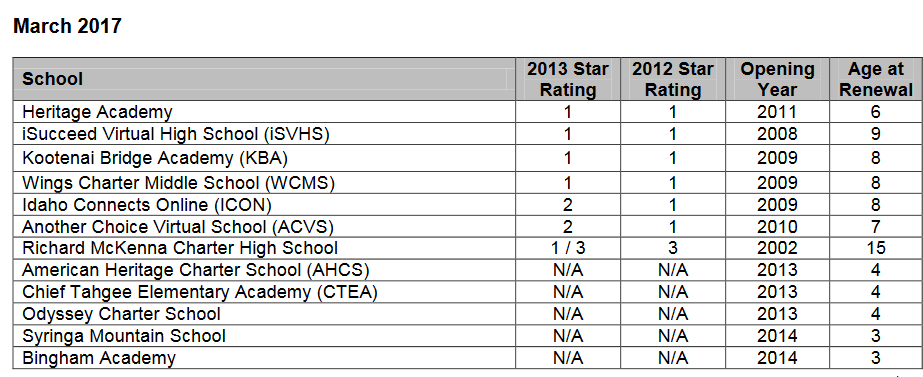
The Second part of this Newsletter is much more serious—because is it advises you as a parent of an Idaho charter school student that the State of Idaho’s Charter School Commission will, in January 2017, begin the first ever Charter School Renewal Process.  Eventually each Charter School will be reviewed and, if found deficient, will be closed. (The March 2017 Renewal schedule.)

Coalition members will need to be actively engaged in this process as it is expected that the Commission staff will suggest that up to 10% of all current Idaho Charters will be shuttered.


***NEW NATIONAL EDUCATION POLL***

“If this year has taught us nothing else, it's that Americans have had just about enough of their betters deciding what's best for them and expecting them to play gratefully along. Reformers might have to start accepting that our greatest point of leverage is to help parents choose wisely, rather than trying to police their choices by means of aggressive accountability schemes.” -Robert Pondiscio, Contributor, U.S. News & World Report, 12/2/16

Dear School Choice Champions-

After last month’s election we commissioned a national poll to gather voter attitudes about high-stakes, standardized testing and what the results of those tests are used for. The results are pretty striking.

Voters are speaking loud and clear: DO NOT CLOSE SCHOOLS BASED PRIMARILY ON TEST SCORES

• Voters overwhelmingly oppose closing schools based primarily on low standardized test scores

• Voters don’t view high-stakes, standardized testing to be the best measure of school and student success

Yet the education establishment is doubling down on high-stakes testing and using those results to judge your schools and your students. They're wrong. SEND A MESSAGE WITH YOUR DONATION TODAY: Let parents be the judge!

We need accountability systems that focus on individual student growth and improvement. Students shouldn’t be punished just because others in their school may be underperforming.

HELP US KEEP STUDENTS IN THE SCHOOLS THAT WORK BEST FOR THEM!

We will fight for you to have every school choice option available so your child can access the education that works best for them.

Check out all the survey results in this infographic!

 #ITrustParents

Thank you,

Tillie Elvrum

President, PublicSchoolOptions.org


PublicSchoolOptions.org is a national alliance of over 60,000 parents that supports and defends parents’ rights to access the best public school options for their children. The Coalition supports the creation of public school options, including charter schools, online schools, magnet schools, open enrollment policies and other innovative education programs.  Additionally, we advocate for equal access without restrictions to the school that best suits the individual student’s learning needs.

You are receiving this email because the Coalition of Idaho Charter School Families forwarded it to you.


Merry Christmas!! We at the Coalition wish you all a Happy Christmas!


December 12/23/16

Merry Christmas!! We at the Coalition wish you all a Happy Christmas!

We appreciate your faithful following of this Newsletter.  We love to bring you the good news when it happens and the TRUTH ON THE “BAD STUFF” that does happen.

We, at the Coalition of Idaho Charter Schools, will be busy through the Holiday Season, getting ready for the Idaho Legislators who will return to Boise for the 2017 Legislative Session. The Legislative Session starts on January 9, 2017. There are some new Legislators that you will need to get to know, so we will introduce them to you in our Newsletter. As well, because Education is always the #1 issue at the Idaho Legislature, we will introduce to you the Senate and House Education Committee members. We will also provide the email addresses so you can contact them.

As usual in the Idaho Legislature, all Charter Schools have an uphill battle to get Legislators attention. There remains a significant cohort of Legislators who do not like or support Charter/Virtual schools. In fact, these Legislators, backed by teachers unions, work hard to make Charters/Virtual schools go away!  Because 2017 is the first year that a cohort of Charter Schools will be up for Renewal, you should pay VERY CLOSE ATTENTION, as the Charter School Commission staff has indicted that they intend to “Close” some schools—perhaps up to 10% . You do not want your school to ‘GO AWAY’!!!


Surveys Find Charter School Parents More Satisfied Than District-School Parents

DECEMBER 20, 2016
BY DANIEL HUIZINGA

Photo: AP

Politicians and policy experts have argued for two decades about the merits of charter schools, with many studies showing the alternative public schools perform as well or better than traditional tax-funded schools. But what do parents think?

Two large-scale surveys recently provided a closer look. Charter-school parents are, on the whole, much more likely to be satisfied with key aspects of their school’s teaching, academic expectations, and safety.

The 2016 Education Next survey collected data from a random sample of 1,571 respondents who had school-age children living in their household and separated them into categories of charter-school parents, private-school parents and district-school parents. According to the authors, this is the first nationally representative survey to report satisfaction scores from parents in these three categories.

Parents responded on a five-point scale from “very dissatisfied” to “very satisfied” and the results were astonishing. “Among five key characteristics — teacher quality, discipline, expectations for achievement, safety, and instruction in character and values — charter-school parents are, on average, 13 percentage points more satisfied with their schools than are parents of children in district schools,” concluded Harvard professors Paul E. Peterson and Martin West and Harvard postdoctoral fellow Samuel Barrows.

The only category that had a higher percentage of district-school parents reporting “very satisfied” was “school location,” which is unsurprising considering that families often must travel further distances to find a charter school with available openings.

In addition, for many categories of behavioral problems, district-school parents were more likely to report serious problems of students missing class, destroying property, fighting or using drugs than charter-school parents.

School communication for charter schools also tended to be better. “As compared to parents of children in district schools, charter parents are 15 percentage points more likely to say they have communicated with the school about volunteering, and 7 percentage points more likely to report having spoken to school officials about their child’s accomplishments,” the EdNext study found.

It’s important to note that these studies only measure parents’ perceptions and did not measure the actual teacher quality or behavioral issues at these schools. However, the authors note that parents’ opinions of their schools are a crucial variable in the debate over the effectiveness of charter schools. If parents in cities around the country are consistently choosing charter schools and are more satisfied with their performance, the charters must be doing something right.

Peterson, along with Harvard post-doctoral fellow Albert Cheng, also analyzed a 2012 U.S. Department of Education survey of more than 17,000 families and confirmed similar findings as the EdNext survey. Though the Department of Education survey did not explicitly create a category for charter-school parents in the final report, Peterson and Cheng were able to use the original dataset to identify which parents had children in charter schools.

“Compared to parents at assigned-district schools, charter-school parents are 6 percentage points more likely to say they are ‘very satisfied’ with teachers at the school, 13 percentage points more likely to be ‘very satisfied’ with academic standards, and 10 percentage points more likely to be ‘very satisfied’ with both school discipline and communication with families,” Peterson and Cheng found.

The Department of Education survey also allowed the authors to break down survey respondents into specific demographic categories. They found that charter-school parents, on average, reported lower family incomes and were less likely to have earned a college degree. The percentage of minorities was also higher in charter schools than in assigned-district schools.

Even looking at these specific demographic indicators, the charter-school satisfaction scores still hold. “Averaging across all five assessment indicators, the percentage of low-income parents saying they are ‘very satisfied’ is 9 percentage points higher at charters than at assigned-district schools,” the authors concluded.

Charter schools are playing an important role in improving educational outcomes — especially for low-income, minority students in urban areas — and parents are noticing. We should, too.

Daniel Huizinga is a columnist for Opportunity Lives covering business and politics. Follow him on Twitter @HuizingaDaniel.

The Coalition of Idaho Charter Schools wishes you all a very joyous holiday session.

Post Falls 2016 Opportunity to Testify Before Legislative Committee re Funding Equity for Mobile Students

My name is Jane Wittmeyer and I am with the Coalition of Idaho Charter School Families.

I recently met many of you at an IDVA Picture Day and spoke to the larger group of parents regarding taking action on seeking equity in school funding for virtual students and mobile students.

I want to let you know about an opportunity to have your voice heard on the matter of equal funding for virtual school students. There is an opportunity for you to testify before a State Committee that is working on a new funding formula for your students.

The Public School Funding Formula Committee will meet on October 17, 2016 beginning at 11:00 A.M at North Idaho College Workforce Training Center, Room 108 in Post Falls, ID. Public testimony will be heard from 5-7 P.M.

If you attend in person you can speak before the Legislators on the Committee.

If you are not able to attend, you could email your Statement to:

Senator Winder, Co-chair                    cwinder@senate.idaho.gov

Senator Mortimer                                dmortimer@senate.idaho.gov

Senator Bayer                                    cbayer@senate.idaho.gov

Senator Thayn                                    sthayn@senate.idaho.gov                           

Senator Ward-Engelking                     jwardenglking@senate.idaho.gov

Representative Horman, Co-chair       WendyHorman@house.idaho.gov

Speaker Bedke                                   sbedke@house.idaho.gov

Representative VanOrden                   jvanorden@house.idaho.gov              

Representative Dixon                         sdixon@house.idaho.gov         

Representative McCrostie                   jmccrostie@house.idaho.gov   

Sherri Ybarra, Superintendent             infosuperintendent@sde.idaho.gov     

Dr. Linda Clark, Board of Education   board@osbe.idaho.gov


This is a rare opportunity for parents and families to let the Legislators know that you support equal funding for virtual and charter school students. (The current formula discriminates against virtual school students and mobile students.)

I hope you will take this opportunity to let the decision makers know that there is support for equity for virtual school students.

See below for a draft you can use.


Draft Statement for your use.

Statement before the Public School Funding Formula Committee

October 2016                    Post Falls, Idaho

My name is _____________ and I have student(s) in a virtual school. I am here today to request this Committee to address the issue of student mobility in Idaho.  As you know, Idaho’s salary formula is based upon average daily attendance which reflects the number of students in class during a set period at the beginning of each school year. This is an old model and needs to be changed to reflect student mobility.

Students don’t stay in one school like they used to. Many students move from one school to another for different reasons during the year. Idaho needs to adopt a new funding formula that accurately reflects actual enrollment.

Clearly, Idaho funds a vastly different school system in 2016. From classroom technology to dual-credit courses to virtual charter schools, the demands on state K-12 dollars have changed.

The old funding formula shows its age in many ways.

I agree, with Rep. Wendy Horman’s recent statement: No one has trouble identifying shortcomings in the current system…. myriad line items fall short of funding needs…Charter school advocates want money to accommodate students who transfer midyear — and they’d like help in 2016, not later.

Thank you for the opportunity to come before the Committee today.


September 30, 2016


September 30, 2016

There is a lot happening in Idaho Education News.

Of interest to Virtual and Charter School families and students is the Public School Funding Formula Committee. This Legislative Committee will meet once more this summer/fall and will use the testimony taken to construct a new way to finance public school funding.

This is important to all Virtual Schools as they receive much less per student under the current formula. All Virtual School families should email the Committee members and the Legislators and ask them to fund virtual school students equally.

You are urged to Attend the next COMMITTEE meeting or send a message to the following individuals urging for equal funding for Virtual students:


nEXT MEETING: October 17

Post falls, idaho

COMMITTEE MEMBERS

Room 108

Post Falls, ID

NOTICE OF MEETING

Senator Winder, Co-chair                    cwinder@senate.idaho.gov

Senator Mortimer                                dmortimer@senate.idaho.gov

Senator Bayer                                     cbayer@senate.idaho.gov

Senator Thayn                                    sthayn@senate.idaho.gov                           

Senator Ward-Engelking                     jwardenglking@senate.idaho.gov

Representative Horman, Co-chair       WendyHorman@house.idaho.gov

Speaker Bedke                                   sbedke@house.idaho.gov

Representative VanOrden                   jvanorden@house.idaho.gov              

Representative Dixon                         sdixon@house.idaho.gov         

Representative McCrostie                   jmccrostie@house.idaho.gov   


Sherri Ybarra, Superintendent             infosuperintendent@sde.idaho.gov     

Dr. Linda Clark, Board of Education   board@osbe.idaho.gov


OVERHAULING THE WAY IDAHO FUNDS SCHOOLS COULD COST $131 MILLION

Devin Bodkin 09/28/2016


Share

POCATELLO — Lawmakers got their first look at the potential costs to change the way Idaho schools receive state funding — and cost estimates reached $131 million.

“This is a particularly complex and potentially expensive endeavor,” said state budget policy analyst Paul Headlee.

Idaho’s 10-member funding formula committee met Tuesday at Idaho State University to discuss cost projections and data and gather public input. The lawmakers are looking at rewriting Idaho’s complex formula for carving up more than $1.5 billion in K-12 funding.

The daytime portion of the meeting focused on three potential changes driving up overhaul costs:

·         Switching to an enrollment-based funding model, instead of a model based on average daily attendance.

·         Beefing up health coverage for district employees.

·         Allocating more funds for non-certified staff members.

Tuesday evening, committee members heard from a handful of East Idaho teachers and administrators.

MOVING AWAY FROM AN ATTENDANCE-BASED MODEL

The current funding formula shows its age in many ways, and rewriting it has been on the state’s radar ever since it showed up in 2013 as a recommendation from Gov. Butch Otter’s Task Force for Improving Education.

On Tuesday, Headlee and State Department of Education Deputy Superintendent of Public School Finance Tim Hill walked committee members through the pros and cons of handing out funding based on enrollment. A switch could drive up budgets by $57 million to $71 million, Hill said.

The current attendance-based model places a financial burden on districts. Average daily attendance is roughly 95 percent of actual enrollment, Hill said. However, districts still prepare for and incur costs as if 100 percent of students were attending.

An enrollment model would be more stable, but more costly.

What’s more, Hill added, an enrollment model might not be fair to schools with high attendance rates.

“If you have two schools with 100 students apiece, and the school with a lower rate of attendance gets as much money as the one with a higher rate of attendance, some might say that’s unfair,” Hill said.

On the other hand, an enrollment-based model require less staff time for  collecting, reporting and compiling data. The model would also align with mastery-based education — another recommendation from Otter’s education task force and the crux of the effort to revamp the funding model.

Under mastery-based learning, students move through the school system based on their command of subject matter, not seat time in a particular class.

MORE STATE FUNDS FOR HEALTH COVERAGE

East Idaho superintendents consistently rank rising health care premiums as a leading contributor to financial woes and teacher turnover. Blue Cross of Idaho, the state’s largest insurer of teachers and their family members, increased its rates 16.6 percent in 2015, according to a recent report by the Idaho Statesman’s Audrey Dutton.

Districts are often forced to supplement employee health care costs, but the rise has grown too steep. In many districts, employees covered by district-sponsored health care usually end up paying out-of-pocket premiums for family members.

Headlee presented a breakdown of how eight other states handle district health insurance.

In Washington, lawmakers allocate a set amount to districts directly within its funding formula, which is pegged at roughly the same cost budgeted for its state employees.

A similar model in Idaho could cost up to $17 million, Headlee said.

MORE FUNDING FOR NON-CERTIFIED STAFF AND WHAT’S NEXT

Districts must now pay an average of 61 cents for every dollar the state provides for non-certified staff, Headlee said.

Closing this gap would come at another hefty cost: $43.4 million.

With costs mounting, Headlee acknowledged that rewriting the formula will take time.

“These are things that will likely be phased in over several years,” he said.

A committee member also acknowledged the looming task at hand.  “We can see that we’ve got our work cut out for us,” said the committee co-chairman Sen. Chuck Winder, R-Boise.

The committee will also gather input and feedback at another field meeting in Post Falls, scheduled for 11 a.m. on Oct. 17 at the North Idaho College Workforce Training Center, Room 108. The agenda hasn’t been set yet, but a public comment session is scheduled for 5 to 7 p.m.